



TL;DR: Final Fantasy III on Nintendo DS is a full 3D remake of the 1990 Famicom original, developed by Matrix Software and published by Square Enix in 2006. The NDS version was the first time Western audiences could play Final Fantasy III in any form. It introduced a refined job system, fully voiced 3D characters, and Mognet wireless connectivity — making it far more than a simple port.
Game Details at a Glance
| Detail | Info |
|---|---|
| Game | Final Fantasy III |
| Developer | Matrix Software |
| Publisher | Square Enix |
| Original Release (Famicom) | April 27, 1990 (Japan only) |
| NDS Release Date | August 24, 2006 (Japan); November 14, 2006 (North America) |
| Platforms | Nintendo DS (also PSP, PC, iOS, Android) |
| Genre | Role-Playing Game (JRPG) |
| ESRB Rating | E10+ (Everyone 10+) |
| Players | 1 (Mognet wireless feature for bonus content) |
| Series | Final Fantasy |
| ROM Status | Not endorsed here — legal alternatives covered below |
What Is the Final Fantasy III NDS ROM — and Why Does It Still Matter?
Final Fantasy III occupies a curious place in the franchise’s history. Released on the Nintendo Famicom in 1990, it was the last mainline Final Fantasy III NDS ROM game to receive a Western release — arriving in North America only in 2006, sixteen years after its Japanese debut, via the Nintendo DS remake. For an entire generation of Western RPG fans, the NDS version was their first and only way to experience one of the series’ most mechanically inventive entries.
That combination of historical significance, genuine gameplay depth, and long-delayed Western availability explains why Final Fantasy III NDS ROM continues to generate search traffic today — including searches involving terms like “Final Fantasy III NDS ROM.” Most pages ranking for that keyword are ROM repository sites offering downloads with minimal editorial content. This guide does the opposite: a thorough review of the NDS version, a breakdown of the job system and story, and a clear guide to where you can legally play the game right now.
The NDS remake is not a reskin of the Famicom original. Matrix Software rebuilt Final Fantasy III NDS ROM from the ground up — replacing pixel sprites with full 3D character models, adding voice acting, expanding the narrative, and introducing Mognet, a wireless feature tied to the DS’s local connectivity. What emerged was a game that honored the original’s mechanical identity while presenting it in a form that modern players could engage with directly.
Understanding what makes this version special requires going back to where it started.
What Is the Final Fantasy III NDS ROM? Historical Context and Platform Overview
How Did the Original Famicom Version Differ from the 2006 NDS Remake?
Final Fantasy III NDS ROM originally appeared on the Famicom on April 27, 1990, the third title in Square’s flagship RPG series. At the time, it was technically ambitious – the most complicated Final Fantasy III NDS ROM released on the platform, having an extended job system, summon magic, and a longer narrative than any of its predecessors. Despite its intentions, it never left Japan during the Famicom era. Two planned Western localizations were scrapped and the game was unavailable to non-Japanese players for over ten years.
The first official non-Japanese release was Matrix Software’s 2006 NDS remake. Matrix Software didn’t simply translate the original – they reconstructed it totally in 3D. Character sprites became fully modeled characters with individual designs. The four unnamed “Warriors of Light” from the Famicom version became named, voiced protagonists with distinct backstories. Environments moved from top-down pixel art to navigable 3D spaces. The core mechanical structure – especially the job system – survived intact, but all around it was modernized.
Why Did the NDS Version Introduce Final Fantasy III NDS ROM to Western Audiences for the First Time?
Square Enix chose the Nintendo DS precisely because its dual-screen architecture and stylus input presented chances for interface design that matched a remake of an older RPG. The mid-2000s were also a golden time for the portable market, and the DS had built up a strong user base of JRPG enthusiasts with titles like Mario & Luigi: Partners in Time and Castlevania: Dawn of Sorrow.
The decision to aim for the DS also fit the size of the game. The Famicom version of Final Fantasy III NDS ROM was a little game by today’s RPG standards, tho deep mechanically – a logical fit for a handheld system built for session-based play.
What Are the Technical Specifications of Final Fantasy III NDS ROM on Nintendo DS?
The NDS version makes use of the Nintendo DS hardware’s 3D rendering features. The game employs a mix of 3D scenery and turn-based combat with animated 3D character models. The original NDS release featured Japanese voice acting, while the North American and European localizations featured English voice acting. Save data is stored directly on the cartridge, and supports multiple save slots. The Mognet function uses the DS’s local wireless radio to exchange in-game messages with other players who also own the cartridge.
The Job System: The Core Mechanic That Defines Final Fantasy III NDS
How Does the Job System Work in Final Fantasy III NDS?
The job system is the mechanical core of Final Fantasy III NDS ROM – the mechanic that distinguishes it from most JRPGs of the age, and also one that impacted the future of the whole Final Fantasy brand.
You can assign any unlocked job to any of the four player characters at any time during the game. Jobs define what a character can do, how they level up and what equipment they can use. Change a character’s job and their entire combat role shifts accordingly. A party built around two Warriors and two White Mages plays completely differently from a party running Dragoon, Dark Knight, Bard, and Red Mage — and the game is designed to reward experimenting with those configurations.
Job levels operate separately from character levels. Each job gains experience through use, unlocking stronger versions of its abilities over time. A Level 1 Monk hits harder than the identical character at Level 1 assigned as a Scholar, but a high-level Monk unlocks capabilities — greater hit counts, self-healing, enhanced barehanded damage — that a low-level assignment cannot access.
This creates a compounding strategic layer. Job assignment is not just about which roles you want; it is about which jobs your characters have invested in, and which assignments will pay off most efficiently against the challenges ahead.
What Jobs Are Available in Final Fantasy III NDS, and What Makes Each One Useful?
Final Fantasy III NDS ROM features 23 jobs in total, unlocked progressively as the player advances through the story. They span the full range of classic RPG archetypes:
Physical and Offensive Jobs:
- Warrior — Heavy armor, strong physical attacks; a reliable frontline presence early in the game
- Monk — Barehanded combat specialist; scales exceptionally well with job level
- Thief — Agility-focused; can steal items and escape battles efficiently
- Ranger — Ranged bow attacks; can target the back row of enemy formations
- Knight — Defensive tank capable of covering and protecting weaker party members
- Viking — High HP, Provoke ability draws enemy attention; specialized crowd control
- Dragoon — Jump ability bypasses certain attacks; strong against flying enemies
- Dark Knight — Sacrifices HP for high damage; a high-risk, high-reward physical option
- Ninja — Fastest physical job; dual-wield capability makes it effective late in the game
Magic and Support Jobs:
- White Mage — Essential healing and status recovery magic
- Black Mage — Offensive elemental magic; core damage dealer in magic-focused parties
- Red Mage — Hybrid magic and physical capability; versatile but limited at high tiers
- Summoner — Calls summon creatures (Evokers) for powerful area effects
- Sage — Advanced hybrid caster; can use both white and black magic at high levels
- Devout — High-tier white magic specialist; significantly stronger than White Mage at endgame
- Magus — High-tier black magic specialist; endgame equivalent to Devout for offense
Specialized and Utility Jobs:
- Scholar — Identifies enemy weaknesses; can use items with doubled effectiveness
- Geomancer — Uses terrain-based abilities; strong in specific environments
- Bard — Support singer; buffs party members and weakens enemies through song
- Evoker — Early summoner variant; summon effects are random, adding unpredictability
- Onion Knight — Starts extremely weak; becomes arguably the strongest job with very high character and job levels
- Freelancer — Starting job; no specialized skills but passively inherits stats from mastered jobs
How Does the Final Fantasy III Job System Differ from Other Final Fantasy Titles?
Final Fantasy III NDS ROM introduced the idea of switchable jobs to the main series, a mechanic which was refined in Final Fantasy V and pushed even further in Final Fantasy Tactics. Final Fantasy III’s implementation differs from its successors in one key way: rigidity.
In Final Fantasy V, job switching is frictionless. Characters can change between jobs easily, and the ability system allows blending skills from various vocations simultaneously. Final Fantasy III NDS ROM is more restrictive, however: switching jobs in the middle of the dungeon has temporary stat penalties and consumes Capacity Points (a resource in the original, removed in the NDS remake), which discourages constant mid-battle reshuffling and rewards committing to a party configuration for extended periods.
That commitment mechanic makes Final Fantasy III NDS ROM’s version feel more meaningful. Deciding to invest in a Dragoon is not just a decision for a session — it is a strategic commitment for the medium term that will determine how you play for the next few hours.
What Strategic Depth Does the Job System Offer for Party Customization?
And depth is as much a question of necessity as of flexibility. Final Fantasy III NDS ROM’s boss design specifically challenges parties that lean too heavily on any single approach. Several bosses are immune to physical attacks, forcing magic-heavy configurations. Others resist magic totally, necessitating a corporeal party. Some encounter sequences encourage speed; others demand sustained healing output.
The game essentially teaches players to read encounter requirements and reshape their party accordingly — not constantly, but deliberately. That rhythm of assessment and adjustment is what gives the job system its enduring appeal.
Story and Characters in Final Fantasy III NDS
What Is the Story of Final Fantasy III NDS, and Where Is It Set?
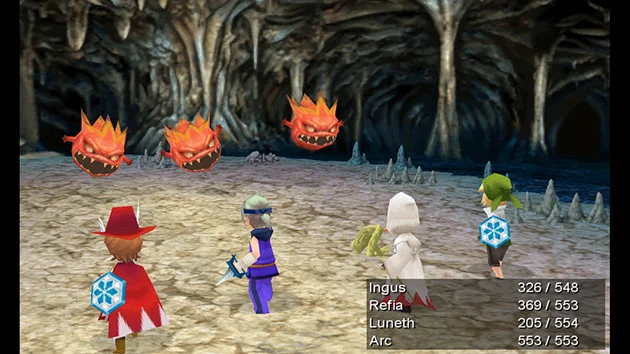
The story of Final Fantasy III NDS ROM takes place on the Floating Continent, a landmass which floats above a world of ocean, known as Florina in the NDS version. The world is governed by the crystals of light, which maintain the elemental balance of the continent. When the crystal of wind awakens four young adventurers, they are tasked with traveling across Florina and the world below to restore balance after a supernatural darkness begins consuming both realms.
The general plot follows the familiar Final Fantasy III NDS ROM formula of chosen heroes restoring elemental order, but the NDS version adds layers that the Famicom original didn’t have. The extended plot provides each protagonist a clear past and relationship to the issue – a meaningful update that makes the trip feel personal rather than stereotypical.
Who Are the Main Characters in Final Fantasy III NDS?
The NDS remake replaced the Famicom’s anonymous Warriors of Light with four named characters:
- Luneth — An orphan raised in the town of Ur; the de facto lead protagonist. Impulsive and energetic, he is the first to discover the wind crystal.
- Arc — Luneth’s childhood friend; bookish and cautious. Arc provides the party’s more measured perspective.
- Refia — A blacksmith’s daughter from Kazus with a talent for healing magic. Her background gives her a specific connection to one of the game’s early story threads.
- Ingus — A knight in service to the King of Sasune. More formal than his companions, Ingus anchors the party’s moral compass.
Two additional party members join temporarily during specific story sections, expanding the cast and adding brief but meaningful narrative context to key plot moments.
What Themes and Narrative Structures Are Unique to the NDS Version?
The NDS version develops themes of responsibility, sacrifice, and the cost of power more explicitly than the Famicom original allowed. The expanded character backstories ground the abstract crystal mythology in personal stakes — each protagonist has reasons to care about the world beyond their role as a chosen warrior.
The narrative also uses the concept of light and darkness more deliberately than the Famicom version. The world below the Floating Continent, shrouded in perpetual darkness, represents both a physical location and a thematic counterweight to the crystal-lit world above. The party’s journey between these spaces mirrors the central conflict between balance and corruption that drives the plot.
NDS Version Features and Enhancements Over the Original Famicom Release
What Graphical Changes Did the NDS Version Make to Final Fantasy III NDS ROM?
The shift from Famicom sprite art to full 3D was the most visible transformation. Matrix Software built character models with individual designs — distinctive silhouettes, animated expressions, and job-specific visual variants when characters change their assignments. Environments shifted from tile-based dungeon maps to navigable 3D spaces with depth and lighting.
The 3D graphics are modest by home console standards — the DS hardware had clear limitations — but they serve the game well. The visual clarity of the 3D environments makes navigation more intuitive than the original’s labyrinthine dungeon maps, and the character designs give the protagonists an identity the Famicom Warriors of Light never had.
How Did Touch-Screen Controls and Dual-Screen Layout Improve the NDS Experience?
The DS’s dual-screen layout handles menu management cleanly. The top screen displays the battlefield or environment, while the bottom screen serves as the primary interface for menus, maps, and job selection. Touch input allows direct menu navigation without cycling through options with a directional pad — a quality-of-life improvement that keeps the game’s interface from feeling dated.
During combat, the bottom screen displays character status, job information, and action commands simultaneously. Players can monitor party health, magic reserves, and ability options at a glance, which reduces the friction of managing a four-character party across long dungeon sequences.
What Is the Mognet Feature, and How Does It Use DS Wireless Connectivity?
Mognet is a messaging system exclusive to the NDS version, and uses the DS’ local wireless capabilities. Players can send in-game letters to other Final Fantasy III NDS ROM owners — short missives delivered by Moogle courier in the game’s fiction. Sending and receiving a sufficient number of Mognet messages unlocks a bonus dungeon, the Crystal Tower sidequest area, which is otherwise inaccessible.
The Mognet feature was forward-thinking for 2006 — social connectivity built into a single-player RPG was uncommon on handheld hardware at the time. In practice, meeting the Mognet requirement is harder today than it was at launch, as it involves coordination with other physical cartridge owners. Some later releases and ports resolve this with different unlock techniques.
What Other Quality-of-Life Improvements Did the NDS Remake Introduce?
The NDS version eliminates the Capacity Point penalty for switching tasks mid-dungeon that existed in the Famicom original. This makes the job system more approachable without sacrificing its strategic depth – players can now swap tasks as needed without being punished for the move.
The remake also incorporated a save point system that the Famicom version did not have, introduced English voice acting for the localized release, and enlarged the global map to include new story locales not present in the original. The frequency of encountering enemies was reduced from the Famicom version, infamous for its aggressive imposition of random battles.
Final Fantasy III NDS ROM vs. Other Final Fantasy Titles
How Does Final Fantasy III’s Job System Compare to Final Fantasy V and Final Fantasy Tactics?
Final Fantasy III NDS ROM introduced the idea of switchable jobs. Final Fantasy V, released in 1992, iterated on it significantly — adding the Ability Points system, which let characters learn abilities from one job and equip them while using another. That cross-pollination of talents gives Final Fantasy V’s employment system greater flexibility and is usually regarded as the more sophisticated implementation.
Final Fantasy Tactics (1997) took the concept in a tactical RPG direction, using a grid-based combat system where job mastery unlocked ability inheritance and character builds became highly specific. Tactics is the furthest extension of the idea that Final Fantasy III NDS ROM set forth.
Final Fantasy III NDS ROM’s version sits between these implementations in terms of flexibility — more restricted than Final Fantasy V, more accessible than Final Fantasy Tactics. Its value is in the commitment mechanic: the fact that job choices weigh in over time gives the system a different strategic texture.
How Does Final Fantasy III Compare to Final Fantasy I, II, and IV?
Final Fantasy I used a job-class system, but characters were assigned their class at the start and could only undergo a single class change mid-game. There was no switching. Final Fantasy II replaced the class system entirely with a skill-growth model where abilities improved through use — a design that proved divisive and was not carried forward in the mainline series.
Final Fantasy IV returned to fixed-class characters, with each party member having a predetermined role that did not change. Cloud Strife in Final Fantasy VII, Tidus in Final Fantasy X, and Lightning in Final Fantasy XIII all follow this same philosophy — characters with defined identities rather than configurable roles.
Final Fantasy III NDS ROM stands as the point where Square first committed to a fully flexible class system, establishing a design lineage that runs directly through Final Fantasy V and into the Tactics series.
What Is Final Fantasy III’s Position Within the Broader Final Fantasy Legacy?
Final Fantasy III NDS ROM is frequently described as the mechanical bridge between the early series and the post-Final Fantasy V era of job-based design. Its influence is clearer in retrospect than it was at the time — the game was absent from Western markets for so long that its contribution to the franchise’s mechanical evolution went largely unrecognized outside Japan until the NDS remake arrived.
The NDS version corrected that gap. It introduced the game to a global audience, generated critical reassessment of Final Fantasy III NDS ROM’s place in the series canon, and created the foundation for the iOS, Android, and PC ports that followed.
How to Legally Play Final Fantasy III Today
Can You Buy a Final Fantasy III NDS Cartridge on the Secondary Market?
Yes. Final Fantasy III was a commercial release in North America, Europe, and Japan, which means physical cartridges exist in large quantities on the secondary market. Pricing has risen since the NDS era, reflecting the game’s cult status — expect to pay approximately $20–$40 USD for a cartridge alone, and $35–$70 USD for a complete-in-box copy with original case and manual.
Reliable sources include:
- eBay — the highest volume of listings; filter for sellers with strong positive feedback and verified photos
- Mercari — growing inventory of retro DS titles; good for finding complete copies
- DKOldies, Lukie Games, and JJGames — U.S.-based retro game retailers that test cartridges before listing
- Local game stores and retro shops — physical copies appear regularly; JRPG titles with dedicated fan bases tend to surface in higher-quality condition than mass-market titles
The game plays on original Nintendo DS, DS Lite, DSi, 3DS, and 2DS hardware. The 3DS and 2DS systems are fully backwards compatible with DS cartridges.
Is Final Fantasy III Available on Virtual Console or Modern Digital Storefronts?
The NDS version of Final Fantasy III NDS ROM was not made available on the Nintendo eShop before its closure for DS and 3DS purchases in March 2023. As of 2025, there is no official digital storefront offering the NDS version specifically.
The Nintendo DS version was, however, followed by official ports to other platforms that remain available:
- iOS and Android — Square Enix released a mobile version of Final Fantasy III NDS ROM based on the NDS remake. It is available on the App Store and Google Play, updated for modern mobile hardware.
- PC (Steam) — A PC version of the 3D remake is available on Steam, offering the closest equivalent to the NDS version’s visual and mechanical presentation on modern hardware.
- PSP (Japan only) — A PSP version was released in Japan in 2012 but was not localized for Western markets.
The Steam and mobile versions are the most accessible legal options for players without DS hardware.
What Are the Differences Between the NDS Version and the Mobile/PC Ports?
The mobile and PC versions use the same 3D remake that was done for the NDS, but with updated character models and some interface tweaks. The most notable gameplay difference is the Mognet feature — the wireless connectivity mechanic tied to the bonus dungeon was removed or modified in non-DS versions, with the unlock conditions adjusted to not require physical cartridge proximity.
Touch input is the primary means of control throughout. The PC version supports keyboard, mouse and controller input. Both versions lose the dual-screen interface that made menu management on the NDS version so seamless, but they both retain the basic job structure and story.
Where Can You Find the Final Fantasy III NDS Cartridge for the Best Price Today?
For the most competitive pricing, eBay and Mercari offer the widest selection and lowest floor prices. Retro game retailers like DKOldies and Lukie Games price slightly higher but provide condition guarantees and tested cartridges. The Steam version, currently priced at approximately $15.99 USD, represents the most affordable legal option for players who do not specifically require the NDS experience.
Final Fantasy III NDS ROM — Emulation Context and Legal Considerations
Why Do Searches for the Final Fantasy III NDS ROM Persist in 2025?
Three factors converge. The NDS is a retro platform and there is no official digital storefront at the moment. Physical cartridges require dedicated hardware. And the game carries significant nostalgic and historical weight for a generation of Western JRPG fans who encountered it on the DS in the mid-2000s. These factors combine to perpetuate the search traffic for ROM-related terms, whether legal or illegal.
Most pages ranking for “Final Fantasy III NDS ROM” are unauthorized aggregators. They answer a download query but provide almost no substantive information about the game itself — no breakdown of the job system, no explanation of the NDS-specific features, no historical context. This guide is the opposite.
What Are the Legal Considerations Around Final Fantasy III NDS Emulation?
Downloading and using DS emulator software – MelonDS and DeSmuME are the two most popular – is legal. These apps emulate DS hardware , but do not include proprietary Nintendo code . The only legal issue is about ROM files.
Final Fantasy III NDS ROM remains under copyright held by Square Enix. Downloading a ROM file without owning a physical cartridge is generally considered copyright infringement under U.S. copyright law and most international equivalents. The age of the game and its retro platform status do not create a legal exception.
The personal backup argument — that generating a digital replica of a cartridge you lawfully possess may qualify as fair use — has not been definitively argued in U.S. courts. It remains the most legally acceptable position for using ROM files in conjunction with emulation software, although it is not a fixed legal protection.
How Does Emulation Compare to Playing on Authentic NDS Hardware?
MelonDS gives people with physical cartridges the same benefits of save states, higher resolutions and playing on the PC instead of the original hardware. MelonDS is the preferred emulator for DS titles in 2025 – it is actively maintained and properly duplicates the DS’s dual-screen layout and touch input via mouse or touchscreen-enabled devices.
DeSmuME is a functional alternative but has seen less upgrades in recent years. Final Fantasy III NDS ROM works fine on both emulators without any major concerns. The emulated version does not include the bonus dungeon related with the wireless Mognet feature since that feature cannot be reproduced.
Frequently Asked Questions About Final Fantasy III NDS
What is Final Fantasy III NDS, and is it different from other versions of the game?
Final Fantasy III NDS is a full 3D remake of the 1990 Famicom original, developed by Matrix Software and published by Square Enix in 2006. It was the first version released outside Japan. The NDS version replaced anonymous sprite characters with named, voiced protagonists, rebuilt environments in 3D, added the Mognet wireless feature, and removed the Capacity Point penalty for job switching. The core job system and story structure were preserved from the Famicom original.
How many jobs are available in Final Fantasy III NDS?
Final Fantasy III NDS features 23 available jobs, unlocked progressively throughout the game. These range from physical classes like Warrior, Monk, Dragoon, and Ninja to magic classes like White Mage, Black Mage, Sage, and Summoner, as well as support and hybrid roles like Bard, Scholar, and Red Mage. The Onion Knight job is technically available from the start but becomes viable only at very high character and job levels.
Is it legal to download a Final Fantasy III NDS ROM?
No. Final Fantasy III remains under copyright held by Square Enix. Downloading a ROM file without owning a physical cartridge is generally considered copyright infringement. Legal alternatives include the Steam version (approximately $15.99 USD), iOS and Android mobile versions, and physical NDS cartridges available on secondary markets for $20–$40 USD.
Where is the best place to buy Final Fantasy III NDS legally?
Physical cartridges are available on eBay, Mercari, and retro game retailers including DKOldies, Lukie Games, and JJGames. The Steam version is the most affordable and accessible digital option. iOS and Android versions are available through the App Store and Google Play. None of these alternatives are available on the Nintendo eShop, which closed DS and 3DS purchases in March 2023.
How long does it take to complete Final Fantasy III NDS?
The main story campaign in Final Fantasy III NDS takes approximately 25–35 hours depending on grinding, job experimentation, and exploration pace. Completionists pursuing all optional content — including the Mognet bonus dungeon on the NDS version — should expect 40–50 hours. The game’s job mastery system extends replayability for players who want to fully level multiple job configurations.
What is the Mognet feature in Final Fantasy III NDS?
Mognet is a wireless messaging system exclusive to the NDS version that uses the DS’s local wireless radio. Players exchange in-game letters with other Final Fantasy III NDS cartridge owners. Sending and receiving a threshold number of Mognet messages unlocks the Crystal Tower bonus area, inaccessible through normal gameplay. This feature was removed or replaced with alternative unlock conditions in subsequent PC and mobile ports.
Can Final Fantasy III NDS be played on a 3DS?
Yes. All Nintendo 3DS and 2DS models are backwards compatible with Nintendo DS cartridges. Final Fantasy III NDS plays without modification on 3DS and 2DS hardware. The game runs in the DS’s native resolution displayed in the center of the 3DS screen, rather than stretched to fill the larger display. Holding Start or Select while the game loads on a 3DS scales the image to fill the top screen at slightly reduced sharpness.
How does Final Fantasy III NDS compare to Final Fantasy V’s job system?
Final Fantasy III introduced the switchable job system to the series; Final Fantasy V refined it. The key difference is flexibility. Final Fantasy V allows characters to mix abilities from multiple jobs simultaneously through its Ability Point system. Final Fantasy III requires committing to a single job at a time, with no cross-job ability inheritance. Final Fantasy III’s version creates more weight behind job choices; Final Fantasy V’s version gives players more moment-to-moment customization. Both are worth playing — they offer distinctly different strategic textures.
Why Final Fantasy III NDS Still Deserves Your Attention
ROM repository pages dominate the search results for “Final Fantasy III NDS ROM.” Those pages answer a download query and nothing else. The actual game — its historical significance, mechanical depth, and genuine quality as a handheld RPG — gets almost no coverage in that context.
Final Fantasy III NDS is a landmark title. It was the first legitimate opportunity Western players had to engage with a mainline Final Fantasy entry that had been absent from the franchise’s global history for sixteen years. The job system it carries is the direct ancestor of Final Fantasy V’s more celebrated implementation, and the NDS remake presented it in a form that holds up clearly in 2025.
Physical cartridges are available and affordable. The Steam version costs less than a movie ticket. Mobile versions are accessible on any current smartphone. There is no meaningful barrier to playing Final Fantasy III legally — and the game rewards the effort.
For different players:
- Final Fantasy series veterans who skipped the DS era: The NDS version is the definitive way to experience Final Fantasy III. The 3D remake is the version Square Enix has built every subsequent port from, and it handles the job system with the clarity the Famicom original’s interface couldn’t fully provide.
- Players who started with Final Fantasy V: Play Final Fantasy III to understand where the job system came from. The commitment mechanic — the fact that job choices carry real strategic weight over time — creates a different experience than Final Fantasy V’s freer approach.
- Retro DS collectors: Final Fantasy III NDS is a high-quality JRPG at a reasonable secondary market price. Complete-in-box copies are worth the premium for serious collectors.
- Players exploring emulation: Own the cartridge or purchase the Steam version first. Legal access costs very little. The emulated experience loses the Mognet feature but preserves everything else.
The game is good. The legal options are straightforward. The job system alone is worth the time.

Other Articles